Short answer
What to know first
Start with acrylic for suitable paintable interior gaps with little movement. Start with silicone for suitable flexible joints exposed to moisture, weather or greater movement. The sealant type is only the first filter: both surfaces, expected movement, water and UV exposure, paint, joint design and the current TDS must support the final choice.
Acrylic and silicone are both sold in cartridges and both close gaps, which makes them appear interchangeable. They behave differently after application. A decorating joint that must accept paint has different demands from a shower-screen perimeter or an exterior frame joint that cycles in heat and rain.
There is no universal winner. Start with the applications guide, identify the complete joint, then check the shortlisted products in the current technical library. Movement, curing, primer and exposure limits vary by product.
Start with what the joint needs to do
Write down what the seal must do before comparing cartridges. Is it closing a cosmetic gap before painting, excluding splashed water, following movement between concrete and aluminium, or weather-sealing a perimeter? A single line can have more than one demand. A window perimeter, for example, may need adhesion to two unlike surfaces, movement capacity and long-term weather resistance while remaining visually neat.
Separate a static-looking gap from a movement joint. Materials change dimension with temperature, moisture and loading even when the movement is difficult to see. Acrylic is often practical for suitable lower-movement interior finishing. Silicone is elastic and commonly considered for wet or weather-exposed joints. Neither family automatically suits every member of those broad categories; the specific product and joint detail still control.

Paintability depends on both sealant and paint
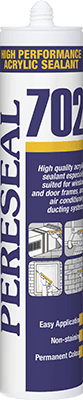
Acrylic sealants are usually the first type to check when the finished joint must be painted. The water-based material dries as water leaves the bead, and the surface can accept suitable paint when both product instructions allow it. Pereseal 702 is the current paintable acrylic in the range. Check that its uses and limitations match the surfaces, movement, moisture and painting sequence before work begins.
Paint can still crack, craze, discolour or remain tacky over a nominally paintable sealant. Causes include painting before sufficient drying, a coating that cannot follow joint movement, a thick or misshapen bead, and incompatibility between the coating and sealant. The dedicated guide on painting over sealant explains the test patch and sequencing questions in more detail.
Moisture and weather narrow the options
A bathroom or kitchen perimeter sees humidity, splashes, cleaning residues and movement between unlike materials. An exterior joint adds UV, rain, heat, cooling and sometimes prolonged dampness. A suitable silicone is commonly the stronger starting family for these conditions because it remains elastic and is available in sanitary and weatherproof formulations. This is not permission to treat every silicone as suitable for every wet detail.
A “waterproof” description does not automatically cover immersion, below-water use, tanking or membranes. Anti-fungal protection also does not replace drainage, cleaning and ventilation. Use the bathroom and kitchen guide or exterior weatherproofing guide to define the exposure, then check the exact product TDS.
Also check how soon the joint will face water or weather after application.
Check both surfaces and the cure type
Name both bonding faces, including coatings. “Window joint” is incomplete; powder-coated aluminium to painted render is more useful. Porous masonry, glass, ceramic, sensitive metals, natural stone, plastics, paints and existing sealants can react differently to a product. Adhesion, staining, corrosion and plastic compatibility may not be visible during application, which is why a product-specific compatibility or adhesion check can be necessary.
Silicone also divides into cure families. Acetoxy silicones release an acidic-smelling by-product and are commonly used on suitable glass, ceramic and other non-porous materials. Neutral-cure silicones are considered for a broader range of construction surfaces and sensitive interfaces, subject to the product TDS. Read neutral-cure vs acetoxy silicone before treating all silicone as one option.
Poor joint design can make the right sealant fail
A product can be suitable in principle and still fail in a badly formed joint. Excess depth, inadequate width, a feather-thin edge or adhesion to the back of a moving joint changes how strain concentrates. Movement joints are commonly detailed for adhesion to the two opposing faces, with backing or a bond breaker controlling depth and preventing a third bond. The required dimensions depend on the product and assembly.
Do not use a simple width-to-depth rule as a substitute for design. ASTM C1193 treats the sealant, primer, backing, substrate preparation, environment and installation as connected parts of a joint seal. The joint-design basics guide explains these relationships and identifies when the detail should be taken to the designer or technical representative.
Choose the exact product after choosing the sealant type
Once the conditions point to acrylic or silicone, compare the products in that group. Check Pereseal 702 for architectural acrylic work, AF for sanitary joints, N for neutral-cure weatherproofing, and MP or 802 for suitable acetoxy applications on non-porous surfaces. Use these descriptions to narrow the options, then confirm the exact use in the current TDS.
Open the latest TDS and check intended uses, excluded surfaces, movement class where stated, preparation, primer, application temperature, cure conditions, paintability and exposure limits. Use the SDS for hazards and handling. Confirm that you have the current document revision before specifying the product.
For site work, write the chosen product beside the joint location and both surface materials. Include colour, pack size, backing, primer, preparation method and curing time. This short record prevents one white cartridge from being used across several joints that look similar but face different movement, moisture or paint requirements.
Record the final choice in a joint schedule rather than relying on cartridge colours. Include both surfaces, location, dimensions, expected movement, water and UV exposure, paint, preparation and required documents. Check the current Pereseal TDS against the schedule and mark anything that still needs a site trial or technical confirmation. This matters when several white joints look alike but do different jobs: an interior trim gap, kitchen perimeter and exterior frame should not receive one specification simply because it is easier to order.
Decision aid
Choose the right product and document
Use this guide to narrow the options, then confirm the exact product and joint details.
Paintable interior gap
Review Pereseal 702, then confirm movement, drying, coating compatibility and exposure in the current TDS.
Bathroom or kitchen joint
Review a sanitary silicone and confirm both substrates, water exposure, cure protection, ventilation and maintenance requirements.
Exterior perimeter joint
Review a weatherproof neutral-cure silicone, expected movement, UV/water exposure, backing, primer and project joint design.
Unusual or safety-critical joint
Stop at the shortlist and obtain current documents plus project-specific technical advice; do not infer suitability from chemistry alone.
Evidence
Primary sources used
- ASTM C1193-25 — Standard Guide for Use of Joint SealantsASTM International
General joint-design, substrate-preparation, backing, primer, installation, environmental and maintenance considerations; explicitly excludes structural glazing.
Accessed 16 July 2026 - ISO 11600:2002 — Classification and requirements for sealantsInternational Organization for Standardization
The principle that building sealants are classified by application and performance characteristics rather than by a generic chemistry name alone.
Accessed 16 July 2026 - Which sealants can I paint over?Bostik
General comparison of paintable acrylic joints and elastic exterior silicone selection; not a substitute for either product document.
Accessed 16 July 2026
Next step
Compare the joint before choosing a product
Use the application pages to describe the exposure and both surfaces, then read the current product TDS before specifying or applying.
Choose by application