Short answer
What to know first
Silicone is commonly the first family to review for durable weather, glazing and sanitary elasticity; polyurethane is a construction-joint option where toughness and paintability may matter; hybrid polymer products can combine flexible sealing with practical bonding. These are family tendencies, not project approvals. Choose from the two substrates, movement, exposure, finish, load path and current product documents, then verify the exact formulation.
Silicone, polyurethane and hybrid polymer sealants all produce flexible joints, but their strengths, limitations and typical roles differ. A family comparison is useful only after the task is defined. An exposed façade perimeter, concrete movement joint and panel-bonding detail may each value different combinations of elasticity, UV stability, paintability, toughness and initial support.
This guide connects the current product range to common applications without treating different sealant types as interchangeable. Pereseal currently offers silicone and acrylic products. Polyurethane and hybrid sealants are discussed only for comparison; they are not part of the current Pereseal range.
Decide whether you need sealing, bonding or both
A sealant spans a joint and accommodates movement while controlling air, water or contaminants. An adhesive transfers load between parts. Hybrid products may be marketed for both, but the application method and evidence change with the primary function. A thick bonding bead behind a panel is not designed or inspected like an exposed weather seal, even when the same chemistry family can appear in both roles.
State the load path, temporary support and consequence of failure. “High bond strength” does not approve structural, overhead or safety-critical use. If a component depends on the material for support, confirm allowable substrates, bead geometry, cure, load, environmental exposure and any mechanical restraint in the current technical documentation. Contact the technical team when a bonding application needs product-specific guidance.

Silicone suits flexible weather and wet-area joints
Building silicones are widely used for suitable glazing top seals, façade perimeters, sanitary joints and other details that need long-term elasticity and resistance to weather or UV. They are generally not painted with conventional coatings. Acetoxy and neutral-cure subfamilies have different substrate considerations, and sanitary additives or weatherproof positioning belong to specific formulations rather than every silicone.
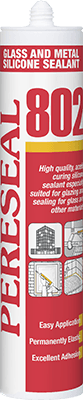
For suitable uses, check Pereseal N for neutral-cure weatherproofing, AF for sanitary joints, and 802 or MP for acetoxy applications. None is automatically suitable for structural glazing, natural stone, immersion or every plastic. Use the neutral versus acetoxy guide and the individual TDS to check both surfaces.
That strength still depends on a compatible substrate, suitable cure family and maintainable geometry. It does not automatically make silicone paintable, suitable for every stone, approved for structural glazing or qualified for permanent immersion. Treat each of those as a separate evidence question.
Polyurethane suits some construction joints, but check exposure limits
One-component polyurethane sealants are commonly considered for concrete, masonry, precast and other construction joints where elastic movement, toughness and potential overpainting are useful. The substrate condition, moisture, primer and joint geometry matter greatly. Family reputation for adhesion is not a substitute for preparing sound faces or confirming the actual coating, concrete age and exposure.
UV, colour stability, chemical contact, traffic and water exposure must be checked for the specific formulation. Paintability also requires a compatible coating and enough cure. Pereseal does not currently offer a polyurethane sealant, so consult the technical team rather than treating a current silicone or acrylic product as an automatic substitute. When the current range has no suitable candidate, do not force a substitution.
Hybrid sealants combine useful features, but products differ
“Hybrid,” “MS polymer,” “SMP” and related market terms cover formulations intended to combine practical adhesion, flexible sealing, low odour and paintability. Some products tolerate damp conditions or offer high initial grab, but those features are not universal. The exact polymer, fillers and additives determine performance. Compare a named product, not an assumed chemistry stereotype.
Pereseal does not currently offer a hybrid adhesive-sealant. Initial grab is not full cure and does not remove the need to support heavy parts. For any third-party hybrid product, the selected substrate pair, bead layout, temporary support, load and exposure still require product-specific evidence. A technical comparison should separate marketed family traits from values actually stated in current documents.
Compare movement, stiffness and joint shape
Movement classification describes tested extension/compression behaviour under a standard and conditions; modulus describes resistance to deformation at a stated strain. Neither means “stronger” in every application. A low-modulus sealant can place less stress on joint edges, while a tougher material may suit a different service. The project needs a product whose tested behaviour matches the movement and substrates.
Joint width, depth, backing and installation temperature turn product behaviour into an installed detail. A high movement class cannot rescue a joint that begins too narrow or bonds on three sides. Read joint-design basics, then compare the specific TDS dimensional range, primer requirements and expected environmental exposure.
Create the comparison at the designed joint dimensions and service temperature range. A percentage copied from one test method cannot be compared casually with a differently stated property, and neither number rescues poor backing, three-sided adhesion or an opening that is already outside the permitted size.
Consider appearance, paint and future maintenance
Silicone usually remains exposed and depends on the selected colour and neat tooling. Paintable PU and hybrid products may accept compatible coatings, but the paint film may crack when it cannot follow movement. Dirt pickup, staining, yellowing, UV and cleaning response vary by formulation and environment. A concealed bonding bead has different appearance criteria from a façade seal.
Plan inspection and eventual replacement. Compatibility with an old sealant matters during renovation; applying a different chemistry against residue or adjacent gaskets can create adhesion or migration problems. Record the installed product and batch, retain documents and design access for repair. Do not select only for the easiest first application while ignoring exposure and future removal.
Rule out unsuitable products before comparing options
Compare both surfaces, joint function, movement, water, UV, temperature, chemicals, paint, orientation, load and required proof. Mark any requirement that the TDS does not answer. More advertised features do not make a product more suitable; the best choice is the one that meets every important requirement without guesswork.
Specialist glazing, fire stopping, immersion, potable water, food contact, traffic and safety-critical bonding need a qualified system and professional review. The Pereseal website can help you find products and documents, but it cannot extend a test or approve a project detail. Contact the technical team with the joint requirements and current drawings.
Leave a product off the shortlist if an important requirement is not covered.
Decision aid
Where each sealant type fits
Weather, glazing or sanitary joint
Review the appropriate silicone formulation and cure family, then confirm surfaces, movement, exposure and specialist exclusions.
Concrete or masonry movement joint
Review a construction polyurethane with the designed dimensions, backing, primer, cure and UV/water conditions.
Flexible sealing plus practical bonding
Review a named hybrid product, defining the load path, temporary support, bead geometry and service environment.
Fire-rated, structural or unusual use
Stop at the family shortlist and obtain current system evidence and project-specific professional approval.
Evidence
Primary sources used
- ASTM C1193-25 — Standard Guide for Use of Joint SealantsASTM International
General joint-design, substrate-preparation, backing, primer, installation, environmental and maintenance considerations; explicitly excludes structural glazing.
Accessed 16 July 2026 - ISO 11600:2002 — Classification and requirements for sealantsInternational Organization for Standardization
The principle that building sealants are classified by application and performance characteristics rather than by a generic chemistry name alone.
Accessed 16 July 2026 - FAQ and technical bulletinsBostik Singapore
General industry guidance on backing rods, joint dimensions, primers, paint cracking, inspection and sealant terminology; not evidence for Pereseal product performance.
Accessed 16 July 2026 - Joint sealants for building and civil engineeringSika
General explanation of joint dimensioning, backing rods, three-sided adhesion, substrate condition and application workflow; not Pereseal-specific evidence.
Accessed 16 July 2026
Next step
Compare products against the same joint requirements
Use the Pereseal range and application pages to build a shortlist, then check every important requirement in the current product documents.
Compare products